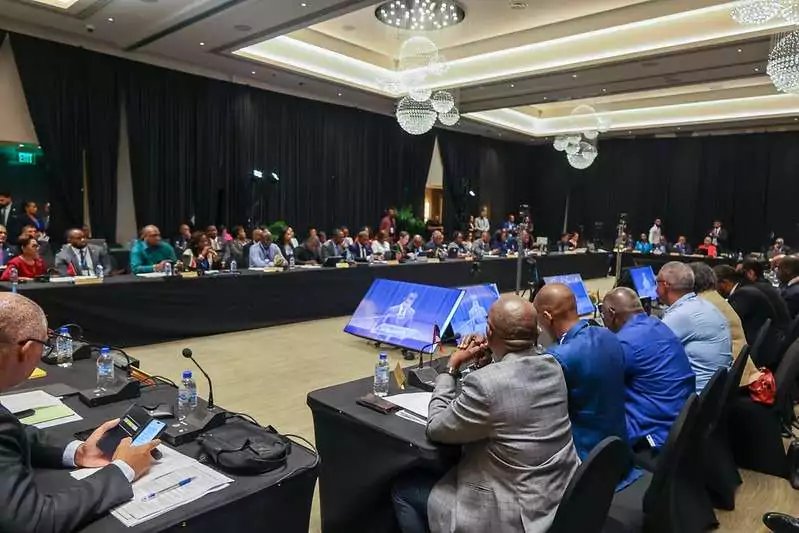
Caribbean Community Heads of Government have agreed to share national strategies aimed at easing the region's rising cost of living, including fuel tax adjustments, expanded welfare programmes, and an accelerated push for an affordable intra-regional ferry service. According to Antigua.news, the agreements emerged from the 51st Regular Meeting of CARICOM Heads of Government, held in Saint Lucia.
Prime Minister Philip J. Pierre of Saint Lucia, who chaired the four-day meeting, told journalists that rising costs were affecting every member state, though leaders acknowledged the region has little control over one of the primary drivers.
"Every island is suffering from an increase in the cost of living," Pierre said. "But there is one factor we have no control over, which is the price of fuel."
Pierre said governments had instead focused on exchanging what has worked domestically. "What we decide to do is we decide to share experiences among ourselves," he said, noting that Saint Lucia and Barbados were among the countries that had already reduced duties on select items to cushion the impact on households.
Barbados Prime Minister Mia Mottley, who leads the Caribbean Single Market and Economy portfolio, said her government had introduced a cost-of-living allowance of $100 per month for pensioners alongside a 30 percent increase in welfare rates. She also noted that some countries are developing apps to provide consumers with real-time price comparisons across stores, replacing reliance on outdated pricing data.
Mottley identified the region's most significant long-term initiative as a planned intra-regional ferry service designed to reduce the cost of moving cargo between islands. She said private-sector efforts to source vessels could take up to a year, but that discussions are underway to use an existing Trinidad and Tobago vessel as a proof of concept in the Southern and Eastern Caribbean in the interim.
"This is a work in progress," Mottley said, adding that treaty arrangements covering mutual recognition of licences and insurance would need to be finalised before cargo vehicles could move freely between ports.
Trinidad and Tobago Prime Minister Kamla Persad-Bissessar said her government was pursuing cost relief through affordable regional healthcare. She pointed to a national facility for fitting artificial limbs and a fully operational children's hospital now being made available to other CARICOM nationals at reduced rates. She added that Trinidad and Tobago was also offering fully trained doctors to support health systems across member states.
St Kitts and Nevis Prime Minister Dr Terrance Drew argued that the region's cost-of-living volatility is fundamentally an energy problem rather than a resource shortage. "We have an energy-harnessing issue," Dr Drew said, citing wind, solar, geothermal, and wave resources that remain largely untapped across the Caribbean.
Dr Drew said St Kitts and Nevis intends to share energy with neighbouring islands, including Antigua and Barbuda, through an undersea cable connection aimed at lowering electricity costs across the region.