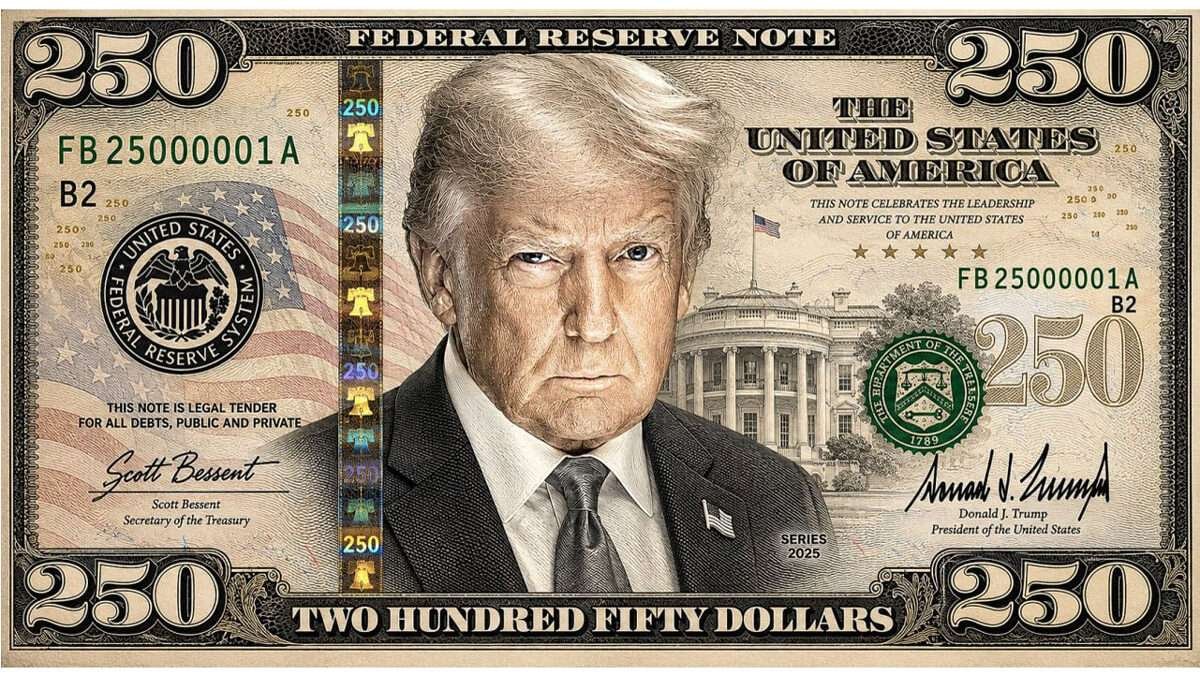
Speculation and political theatre have converged around a striking proposal: that President Donald Trump's face could appear on a future U.S. banknote as the country marks its 250th anniversary of independence. According to Antigua.news, U.S. Secretary of the Treasury Scott Bessent has confirmed that preparations are genuinely under way to print a new $250 note featuring the current president's image, with lawmakers ultimately to decide whether the bills enter circulation.
Bessent confirmed that designs have been drafted and requested by the Bureau of Engraving and Printing (BEP), a sub-agency of the Treasury responsible for developing and producing U.S. currency. Artistic concepts of the bill have not been publicly released.
The proposal faces a significant legal obstacle. Federal law strictly prohibits the depiction of living persons on U.S. currency. Trump allies in Congress introduced legislation last year to create an exception that would allow current and former presidents to be featured on banknotes, but that measure has yet to pass.
If approved by both the House and Senate, the move would shatter a 160-year-old precedent, marking the first time a living person has appeared on U.S. paper money. Since the late 19th century, U.S. paper currency has featured only historical figures who are deceased — a convention designed to avoid political favouritism and ensure broad, lasting national consensus.
Presidents such as George Washington, Abraham Lincoln, and Andrew Jackson appear on current notes, each chosen long after their deaths precisely because their legacies had settled into broadly accepted national esteem. The rule, observed for more than a century, is intended to keep partisan influence away from national symbols.
The Treasury Department has repeatedly reaffirmed this established principle, noting that living individuals are not considered for banknote portraits. Any change would require a significant shift in long-standing policy, along with Congressional approval and the full legislative process.
Experts warn that even if sufficient political momentum were to develop, the process would almost certainly extend well beyond the anniversary year.
Nevertheless, the proposal has gained traction in media commentary and among some political supporters ahead of the 4th of July, who view the semi-quincentennial as a fitting occasion to honour a sitting president.
The idea has sparked both enthusiasm and sharp criticism in equal measure. As a talking point, it reveals much about the current political climate in the United States — and the deepening intersection of personality politics with national symbolism.